
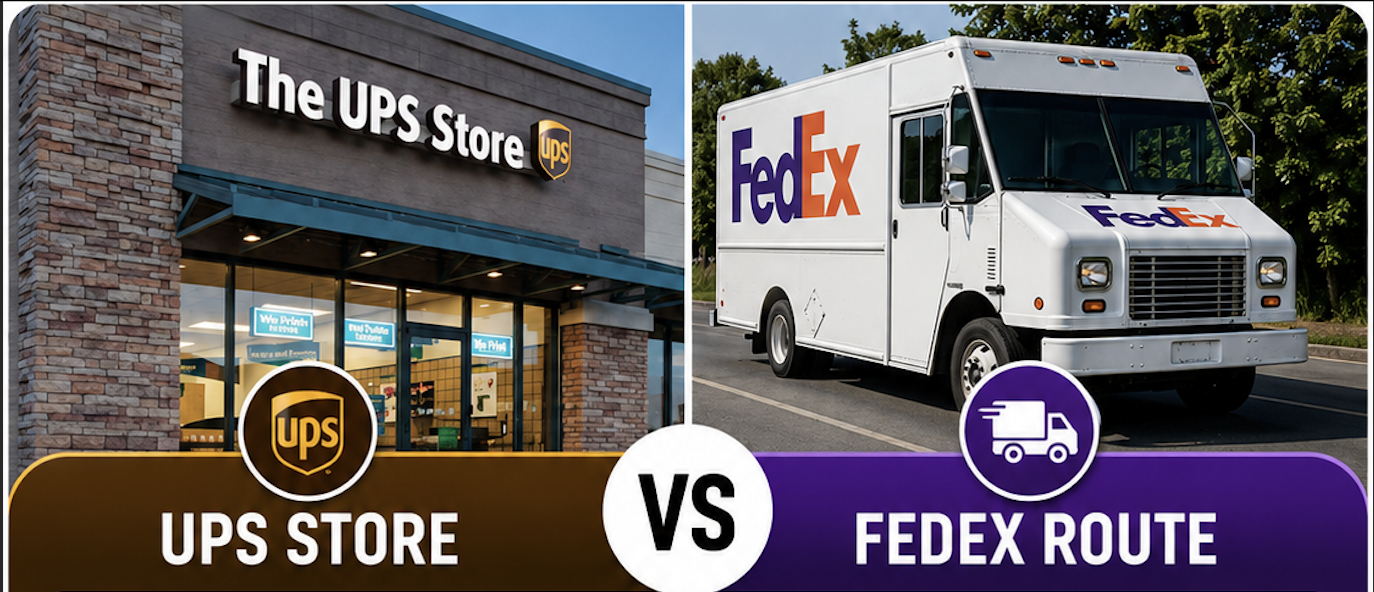
At first glance, a UPS Store and a FedEx Route might seem like similar businesses.
Both are connected to shipping. Both benefit from package volume. Both can appeal to buyers looking for a recognizable business model.
But once you look under the hood, they are very different businesses.
UPS Store vs FedEx Route
In this example, the UPS Store appears to produce slightly more cash flow after debt relative to the initial cash invested.
But that does not automatically make it the better business.
The real question is whether you want to own a retail service location or a logistics operation.
A UPS Store is primarily a retail and service business. Customers walk in to ship packages, rent mailboxes, print documents, notarize paperwork, and use local business services.
That means location, staff quality, customer experience, and local business relationships matter a lot.
A FedEx Route is completely different. You are managing delivery operations, drivers, trucks, route density, maintenance, and service standards.
Customers usually are not choosing your specific route business. They are choosing FedEx, and you are responsible for executing the delivery operation behind the scenes.
What Stands Out About A UPS Store
- Multiple revenue streams: Shipping, mailbox rentals, printing, notary services, business services, and retail supplies.
- Fixed location: Easier to understand operationally than a route-based logistics business.
- Repeat customers: Mailbox customers and local businesses can create recurring revenue.
- Brand recognition: Customers already know the UPS name.
- Expansion path: Growth may come from improving store performance or eventually owning multiple locations.
Potential Risks With A UPS Store
- Retail dependency: Location and foot traffic matter.
- Staffing still matters: Poor counter service can hurt repeat business.
- Franchise constraints: You operate inside a franchise system with rules, fees, and brand requirements.
- Local competition: Printing, shipping, mailbox, and business services can face competition from nearby providers.
What Stands Out About A FedEx Route
- Operational leverage: Route density and efficiency can meaningfully improve profitability.
- Scalable model: Growth may come from acquiring more routes or improving existing route performance.
- Less retail exposure: You are not relying on walk-in customers the same way a storefront does.
- Clear demand driver: Package delivery remains a major part of the economy.
Potential Risks With A FedEx Route
- Driver dependency: Reliable drivers are critical. Callouts and turnover can create immediate problems.
- Vehicle risk: Trucks, repairs, insurance, fuel, and maintenance can eat into cash flow.
- Carrier dependency: You are tied closely to FedEx rules, route changes, package volume, and contractor requirements.
- Operational intensity: A FedEx Route can become a people-and-vehicles business very quickly.
Amazon changed the shipping industry by building more of its own logistics network.
That matters because shipping-related businesses are exposed to changes in package volume, carrier strategy, and how large retailers move goods through the system.
FedEx Routes are more directly exposed to route volume, delivery density, contractor rules, and service expectations from the carrier.
UPS Stores are still exposed to the broader shipping market, but they also have other revenue streams like mailbox rentals, printing, notary services, and local business services.
That diversification can matter when evaluating risk.
The UPS Store may appeal more to someone who wants a storefront business with customer interaction and multiple local revenue streams.
The FedEx Route may appeal more to someone comfortable managing drivers, trucks, logistics, and operational systems.
The mistake would be choosing based only on the cash flow number.
The better question is: which operating model would you actually want to own?